
Guarantor
Agreement.
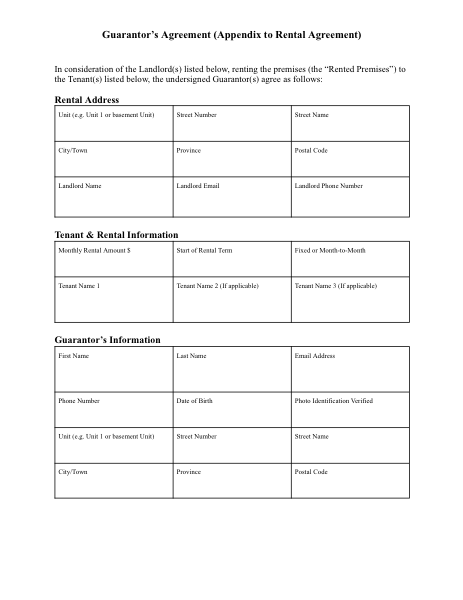
The standard guarantor template used in Ontario rentals. Download the free editable PDF, walk your guarantor through it, and submit it alongside your application to strengthen your file — no printing required.
This document is provided for informational purposes only. TheRentalMarket.ca and its representatives assume no liability for the use, accuracy, or outcome of this document. Always verify the most current version with your real estate professional or legal advisor.
A Guarantor Agreement is a separate contract attached to a residential lease where a third party — the guarantor — promises to cover rent and other lease obligations if the tenant fails to do so. It does not give the guarantor any right to occupy the unit; it is purely a financial backstop for the landlord.
Most landlords and brokerages in Ontario use a standard guarantor template that mirrors the language of the lease. The version above is the most widely accepted format.
The agreement covers rent payments, damages, and any other costs the tenant is liable for under the lease. It typically lasts for the initial fixed-term lease (usually 12 months) and may or may not extend into the month-to-month period that follows — this depends on the wording.
Below is a section-by-section walkthrough so both you and your guarantor know exactly what is being signed.
Tenant & Property Information
Enter the tenant's full legal name, the full rental address (including unit number), the lease start date, the lease term, and the monthly rent amount. These details must match the lease exactly.
Tip: Use the same name format as on the lease and on the guarantor's ID. Mismatches cause delays during landlord verification.
Guarantor Identification
The guarantor enters their full legal name, current address, date of birth, phone number, and email address. They will also need to attach a copy of their government-issued photo ID (driver's licence or passport).
Tip: The guarantor's address must be a Canadian residential address. Out-of-country guarantors are sometimes accepted but require extra documentation (proof of assets, ability to transfer funds).
Guarantor Income & Employment
The guarantor provides their employer name, position, employer phone number, and annual gross income. Self-employed guarantors should attach their most recent Notice of Assessment (NOA) or T1 General. Most landlords expect the guarantor to earn 4–5 times the monthly rent.
Tip: Attach a recent employment letter on company letterhead confirming position, salary, and start date. This is the single strongest piece of supporting documentation.
Scope of the Guarantee
This section defines what the guarantor is on the hook for — usually rent, damages, and any costs the tenant is liable for under the lease. It also defines the duration of the guarantee: most agreements cover the initial fixed term and may or may not extend into month-to-month.
Important: Read this section carefully. If the wording extends the obligation indefinitely, ask the landlord or your agent to limit it to the initial term only.
Credit Check Authorization
By signing, the guarantor consents to a credit check. The landlord or their agent will pull the report from Equifax or TransUnion. This is standard for virtually all guarantor arrangements in Ontario.
Tip: The guarantor should know their credit score before signing. A score of 700 or higher is typically expected; some landlords accept 680+.
Signature & Witness
Both the guarantor and the tenant sign and date the agreement. A witness signature is generally required — this can be a friend, colleague, or family member who watches both parties sign. The witness prints their name, signs, and dates beside their signature.
Tip: Sign in blue ink on physical copies, or use a verifiable e-signature platform (DocuSign, HelloSign). Keep a signed copy for your records.
- Submit it with your application, not after — landlords reward preparedness. A complete package signals that you take this seriously and reduces back-and-forth.
- Attach the guarantor's supporting documents — ID, employment letter, recent pay stubs, and credit consent. The fewer follow-ups required, the faster the decision.
- Offer it before the landlord asks — if you're a newcomer, student, or self-employed, proactively offering a guarantor demonstrates financial seriousness.
- Choose a guarantor who answers the phone — the landlord or agent will call to verify income and identity. An unreachable guarantor delays approval and can sink the application.
- Make sure your guarantor knows what they're signing — walk them through the agreement before signing. A signed but later-disputed guarantee can void the entire arrangement.
For a deeper breakdown of when you need a guarantor and what they need to provide, see our Guarantor & Co-Signer Guide.
A Guarantor Agreement is a contract where a third party (the guarantor) agrees to cover rent and other lease obligations if the tenant defaults. It is a separate document from the lease itself and gives the landlord an additional layer of financial security.
Typically when an applicant has limited Canadian credit history, no rental history, irregular income, or income below the standard 3x monthly rent threshold. Newcomers, students, self-employed applicants, and first-time renters are most commonly asked to provide one.
Most landlords expect a guarantor to earn 4–5 times the monthly rent in gross income, hold a credit score of 700 or higher, and reside in Canada. They will need to provide government-issued photo ID, proof of income, and consent to a credit check.
The guarantee usually covers the initial fixed-term lease (typically 12 months). When the lease converts to month-to-month, the guarantor’s obligation may or may not continue depending on how the agreement is worded. Always read the document carefully before signing.
Landlords can set reasonable financial criteria for tenants, but they cannot use the requirement to discriminate against protected groups under the Ontario Human Rights Code (such as receipt of public assistance or family status). If you believe you’ve been treated unfairly, contact the Human Rights Tribunal of Ontario.