
Guarantor & Co-Signer Guide for Ontario Rentals.
Everything you need to know about guarantors and co-signers for Ontario rentals. Requirements, documents, legal rights, and alternatives for newcomers, students, and anyone with limited credit history.
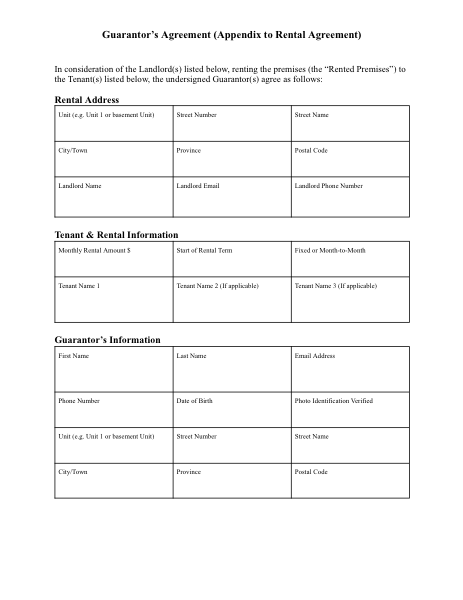
This document is provided for informational purposes only. TheRentalMarket.ca and its representatives assume no liability for the use, accuracy, or outcome of this document. Always verify the most current version with your real estate professional.
Guarantor vs. Co-Signer
Guarantor
Agrees to cover rent if the tenant defaults but is not on the lease as a tenant. They do not live in the unit and have no right to occupy it. Their role is purely financial — a safety net for the landlord.
Co-Signer
Signs the lease alongside the tenant and shares full legal responsibility for all obligations under the lease. They are equally liable for rent, damages, and any other costs. In some cases, a co-signer may also have the right to occupy the unit.
In Ontario, the terms are often used interchangeably by landlords and property managers. Always read the agreement carefully to understand the specific obligations.
A guarantee agreement typically covers rent payments, damages to the unit, and any other costs the tenant is liable for under the lease. The guarantee usually lasts for the initial lease term — most commonly 12 months. When the lease converts to month-to-month, the guarantor’s obligation may or may not continue depending on the specific wording.
When You Need a Guarantor
A guarantor is most commonly required when the tenant’s financial profile does not meet the landlord’s standard approval criteria. Here are the most frequent situations:
- New to Canada: No Canadian credit history, no local references, and no established banking relationship.
- Student without income: Full-time students who do not have a steady source of employment income.
- Self-employed / irregular income: Freelancers, contractors, gig workers, and business owners whose income fluctuates.
- Recovering from poor credit: Previous financial difficulties — missed payments, collections, or a consumer proposal.
- First-time renter: No rental history means the landlord has no track record to evaluate.
What Landlords Are Looking For
When a landlord asks for a guarantor, they are looking for someone who can step in financially if the tenant defaults.
- Income Requirement: Most landlords want the guarantor to earn 4–5 times the monthly rent in gross income. For a $2,500/month rental, that means $10,000–$12,500/month.
- Credit Score: A credit score of 700 or higher is typically expected. Some landlords will accept 680+.
- Residency: Landlords strongly prefer guarantors who live in Canada. Some will accept out-of-country guarantors if they can provide sufficient proof of assets and the ability to transfer funds.
- Commitment: The guarantor must be willing to sign the guarantee agreement and undergo a credit check.
What Your Guarantor Needs to Provide
What Your Guarantor Needs to Provide
- Government-Issued Photo ID — A valid driver’s licence, passport, or provincial photo ID card.
- Proof of Income — An employment letter on company letterhead confirming position, salary, and start date, plus recent pay stubs. Self-employed guarantors should provide their most recent Notice of Assessment or T1 General tax return.
- Credit Report or Consent — Either a current credit report from Equifax or TransUnion, or written consent for the landlord to run a credit check.
- Proof of Canadian Residency — A utility bill, bank statement, or government correspondence showing a Canadian address.
Have your guarantor prepare these documents in advance so you can submit them alongside your own application. A complete package with guarantor docs included signals preparedness and speeds up approval.
Alternatives to a Guarantor
If You Don’t Have a Guarantor
Some landlords accept extra months of rent prepaid. While they cannot legally require it, voluntarily offering 3–6 months upfront can offset the lack of a guarantor.
Other ways to strengthen your application:
- Strong proof of income (employment letter, bank statements)
- A personal cover letter explaining your situation
- Proactive credit report
- Renter’s insurance quote
- Strong professional references
Legal Rights & Responsibilities
Under the Ontario Human Rights Code, landlords cannot discriminate against tenants based on protected grounds including race, place of origin, age, family status, or receipt of public assistance. A landlord cannot refuse to rent to you solely because you don’t have a guarantor — but they can set reasonable financial criteria.
Guarantor’s Rights
- Review the lease agreement before signing
- Negotiate the scope and duration of the guarantee
- Receive a copy of any agreement they sign
Guarantor’s Responsibilities
- Covering rent and potentially damages if the tenant defaults
- Scope of liability depends on the guarantee agreement
- Always read the guarantee carefully before signing
A guarantor is a powerful tool for strengthening a rental application — but both the tenant and guarantor should fully understand the agreement before signing. Read every clause, negotiate the scope, and keep copies of everything.
Ready to Start?
Apply Today.
We help renters across Ontario find and secure their perfect rental. One profile, one agent, completely free for tenants.
Apply Now →