
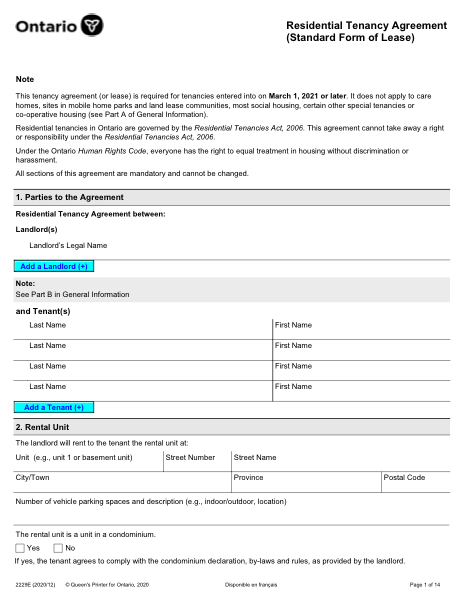
Ontario Standard Lease.
Form 2229E.
The official residential tenancy agreement required by law for most rental tenancies in Ontario. Download the free editable PDF, fill it out on your computer, learn what each section means, and sign with confidence.
This form is provided for informational purposes only. TheRentalMarket.ca and its representatives assume no liability for the use, accuracy, or outcome of this document. Always verify the most current version with the Government of Ontario or your real estate professional.
The Ontario Standard Lease (officially the Residential Tenancy Agreement, Form 2229E) is the standardized lease form created by the Government of Ontario. Since April 30, 2018, it has been legally required for most new residential tenancies in the province.
It uses plain language to lay out the rights and responsibilities of both landlords and tenants — replacing the dense legalese that used to vary from landlord to landlord and often contained illegal clauses.
The form covers parties to the lease, rental unit details, rent and deposits, services and utilities, rules and additional terms, signatures, and includes a plain-language explanation of tenant and landlord rights under the Residential Tenancies Act.
Below is a section-by-section walkthrough so you know what you’re signing and what to look out for.
Parties to the Lease
Lists the full legal name(s) of every tenant and the landlord’s legal name and address for service. The address must be in Ontario — if your landlord lives outside Ontario, they must list a Canadian address where they can be served documents.
Tip: If you’re renting with a partner or roommate(s), make sure all tenants are named here. Anyone not on the lease has no tenancy rights.
Rental Unit Details
The full address of the rental unit, the type of unit (apartment, condo, house, basement suite, etc.), parking spaces, and other included spaces (locker, balcony, etc.).
Important: If parking, locker, or storage is included, make sure it’s explicitly listed here. Verbal promises don’t exist legally — if it’s not in writing, the landlord can take it away later.
Term & Rent
The lease start date, term (fixed term or month-to-month), monthly rent amount, day rent is due, and accepted payment methods. By law, landlords cannot require post-dated cheques or automatic withdrawals.
Tip: After any fixed term ends, the lease automatically converts to month-to-month — you cannot be required to move out or sign a new fixed-term lease.
Services & Utilities
Specifies which utilities and services are included in rent (heat, hydro, water, gas, internet, cable, parking, laundry, etc.) and which the tenant pays separately. Also lists any appliances included.
Tip: Read this carefully. “Heat included” often means the building heat is on, but you may still pay for hydro/electricity separately. Confirm before signing.
Rent Deposit (Last Month’s Rent)
The only legal deposit in Ontario. Amount equals one month’s rent. Landlords cannot legally collect damage deposits, security deposits, pet deposits, or cleaning deposits. Key deposits are limited to the actual replacement cost of keys.
Important: Landlords must pay annual interest on the LMR deposit at the provincial rent increase guideline (2.1% in 2026). They typically apply this as a credit toward future rent.
Smoking, Tenant’s Insurance & Other Rules
The Standard Lease includes a check-box section for smoking rules (allowed/prohibited) and notes whether the tenant must obtain tenant’s insurance (most landlords require it).
It also includes a section for changes to the rental unit (e.g., painting, drilling) requiring landlord consent.
Maintenance & Repairs
Confirms the landlord’s legal obligation to maintain the unit in a good state of repair and comply with health, safety, housing, and maintenance standards under the RTA. Tenants are responsible for ordinary cleanliness and any damage they cause beyond normal wear and tear.
Assignment, Subletting & Roommates
The lease confirms your right to assign or sublet with the landlord’s consent — and the landlord cannot unreasonably withhold consent. The landlord can charge only their actual out-of-pocket costs (typically the cost of a credit check) for processing.
Additional Terms (Where Most Issues Hide)
This is where landlords sometimes try to add illegal or unenforceable clauses — no-pet clauses (void under the RTA), guest restrictions (unenforceable), mandatory move-out clauses (void), pre-authorized debit requirements (illegal), and so on.
Important: Even if you sign clauses that violate the RTA, they are void and unenforceable. But it’s much better to flag and negotiate them before signing.
Signatures
The lease must be signed and dated by all tenants and the landlord. The landlord must give you a signed copy within 21 days of signing. Keep this in a safe place — you may need it for the LTB, your insurer, or future landlord references.
For a deeper breakdown of your protections under the RTA — deposits, evictions, rent increases, pets, and more — see our Ontario Tenant Rights guide.
Yes. Since April 30, 2018, the Ontario Standard Lease (Form 2229E) is required by law for most new residential tenancies signed in Ontario. Exceptions include care homes, mobile home parks, and some social/co-op housing. If your landlord refuses to use it, you have the right to request it in writing — if they don’t provide it within 21 days, you can withhold one month’s rent until they do.
If your landlord asks you to sign a non-standard lease (for a tenancy that legally requires Form 2229E), you can request the Standard Lease in writing. The landlord has 21 days to provide it. If they don’t, you can withhold up to one month’s rent until they do. If they still don’t provide it, you may end the tenancy with 60 days’ notice.
Yes — but those terms must comply with the Residential Tenancies Act (RTA). Any clause that violates the RTA (no-pet clauses, illegal damage deposits, mandatory move-out provisions, etc.) is void and unenforceable, even if you sign it. Read every clause carefully and ask questions before signing.
In Ontario, the only legal deposit is the last month’s rent (LMR). Damage deposits, security deposits, pet deposits, and cleaning deposits are all illegal. Key deposits are limited to the actual replacement cost of keys. Landlords must also pay annual interest on the LMR deposit at the provincial rent increase guideline.
Yes, but with important protections. After the initial fixed term ends (typically 12 months), the lease automatically converts to month-to-month under Ontario law — the landlord cannot force you to sign a new fixed-term lease or move out. You can end a month-to-month tenancy with 60 days’ written notice using LTB Form N9.